
Chandrayaan — India's Triumphant Odyssey to the Moon
Houdini for a ~30-minute fulldome show: fisheye mastering, dome previews on JNP's 6× Zeiss rig, and a delivery pipeline built for the sphere.
- Problem
- Fulldome shows fail when flat-film thinking meets a blended multi-projector dome — scale, composition, and sim detail that read on a 15 m sphere are hard to judge off a monitor.
- Contribution
- As Lead Technical Director at Morpheus+ I built the Houdini pipeline, fisheye mastering workflow, and dome-preview gates for separate Kannada and English masters at Jawaharlal Nehru Planetarium.
- Impact
- A procedural fulldome pipeline that survived in-theater review on a 6-projector Zeiss rig; promo site carries the public visual preview while the full show stays in the dome.
Open live demo — Interactive promo site with fisheye trailer preview; full ~30 min show screens at JNP only.
This project started in March 2025. I am publishing the write-up in August 2026 while the last dome passes are still going back to Taralaya. At Morpheus+ I was Lead Technical Director on a ~30-minute fulldome show for Jawaharlal Nehru Planetarium — separate Kannada and English masters, scripted and directed by Dr B. R. Guruprasad for the Bangalore Association for Science Education.
The interesting part is not the plot. It is building a Houdini pipeline where every sim, surface, and camera move has to read on a full sphere, then surviving frame-accurate review in the actual theater.
A fulldome show is not a wide monitor. If you cannot preview on the dome, you are guessing at scale until the client sits in the seats.
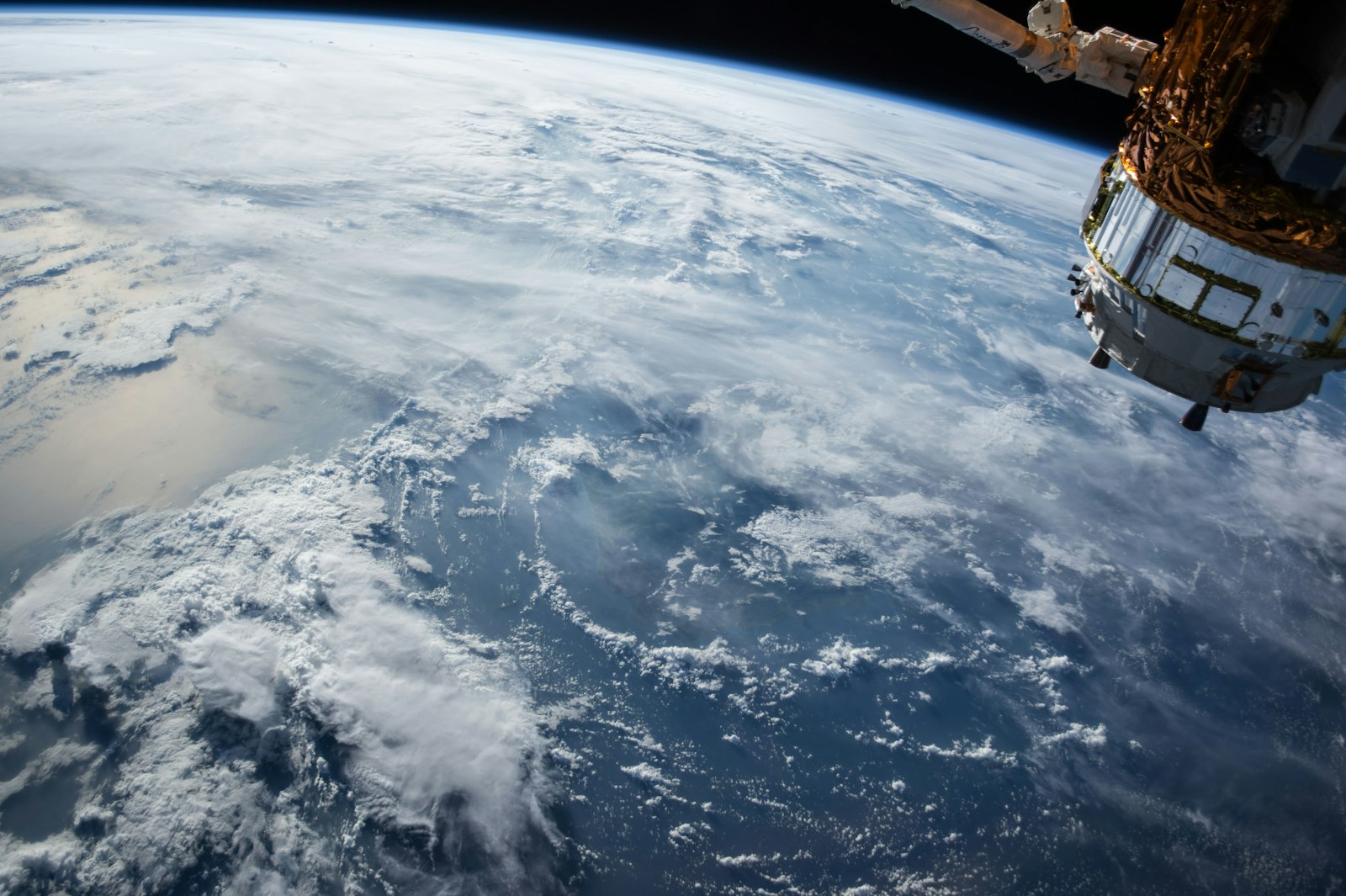
Hero: Earthrise over the lunar horizon (NASA on Unsplash). Production stills from the show will follow once the premiere is public.
Why the dome changes everything
Jawaharlal Nehru Planetarium runs a 15 metre unidirectional dome with 226 seats and six Zeiss 2K projectors blended into one fulldome image. Masters are equidistant fisheye: zenith at the centre of the frame, horizon on the circle, black outside the disc.
That geometry rewires every habit from flat delivery:
- Scale — geometry that looks fine in a rect monitor can shrink into a tight pool at zenith; revision notes kept asking for wider spread and larger on-screen presence.
- Composition — the audience sits on one side; weighting matters differently than a centred 16:9 frame.
- Sim legibility — pyro, smoke, and crowd density that read on a laptop often vanish or blow out once wrapped on 15 metres of screen.
- 2D plates — rectangular archive footage sits inside the fisheye as inset panels; placement and height are dome decisions, not comp afterthoughts.
Monitor dailies are useful for timing and continuity. They are not approval.
Houdini scene architecture
Houdini carried the procedural spine: lunar terrain (multiple surface variants and camera angles), spacecraft motion, mineral and resource map geometry, pyro and smoke sims, and crowd layouts for wide celebratory shots. Licensed models and agency plates filled gaps; the procedural work is what had to survive iteration without rebuying assets.
A few dome-specific rules we kept reinforcing in scene setup:
- Spread, don’t stack — keep hero geometry off a tiny zenith cluster unless the beat demands it.
- Sim scale early — run low-res pyro and smoke with dome preview in mind; fixing scale after a final sim pass is expensive.
- Shared scenes, forked comps — Kannada and English masters share Houdini builds; titles and comp stacks diverge downstream.
- Name for delivery — scene and render paths aligned with the production spreadsheet so frame-accurate VO sync did not become a forensic exercise.
VEX and Python handled the repetitive parts: variant switches, instancing, attribute-driven look dev, and export presets for fisheye cameras.
Fisheye mastering and dome previews
Equidistant fisheye output was the contract end-state. Inside Houdini we rendered with dome-aware cameras, then ran dome preview gates before heavy comp lock: early passes on JNP’s blended rig to catch scale, horizon clutter, and sim readability.
What we checked in-theater (high level):
- Does critical action sit where unidirectional seating can see it?
- Do rectangular plates feel anchored, not pasted at the wrong latitude?
- Do simulations hold contrast after blend, not just on a single projector feed?
- Does motion speed feel correct at full field of view?
The promo trailer uses the same projection math at web resolution; the case study embed below is the public cut, not the full ~30 minute show.
Mixed pipeline
Houdini 3D fed DaVinci Resolve for colour and dome timing, with After Effects for 2D rectangular plates and motion graphics. VO was tracked frame-accurately against picture in a shared spreadsheet; that discipline mattered more than any single hero shot.
Production ran on a ~16-week milestone track: setup and previz, 2D asset waves, 3D modelling, first dome preview, simulation and lighting, comp integration, second dome preview, then final refinements. Jira and the asset list were the source of truth — not inbox threads.
I am not walking through revision history here. The point is that fulldome delivery is a loop: build, preview on the dome, adjust scale and timing, repeat.
Try the trailer
The bilingual promo site is the one place this write-up shows moving picture. Drag to look around on desktop; on a phone, use motion if your browser allows it.
Full show screens at the planetarium only. Booking for schools and other venues is rolling out through Taralaya.
Credits
Fulldome visuals and VFX by Morpheus Plus Dreamscapes Media LLP. Script and direction: Dr B. R. Guruprasad. Scientific consultation and planetarium context from the JNP / BASE team. Spatial audio and score were produced separately at Prabhath Studios; this post is about the Houdini and dome path, not the sound mix.
Workflow stills from production (networks, layout tests, QC grabs) will land here after premiere — nothing that spoils unreleased sequences.